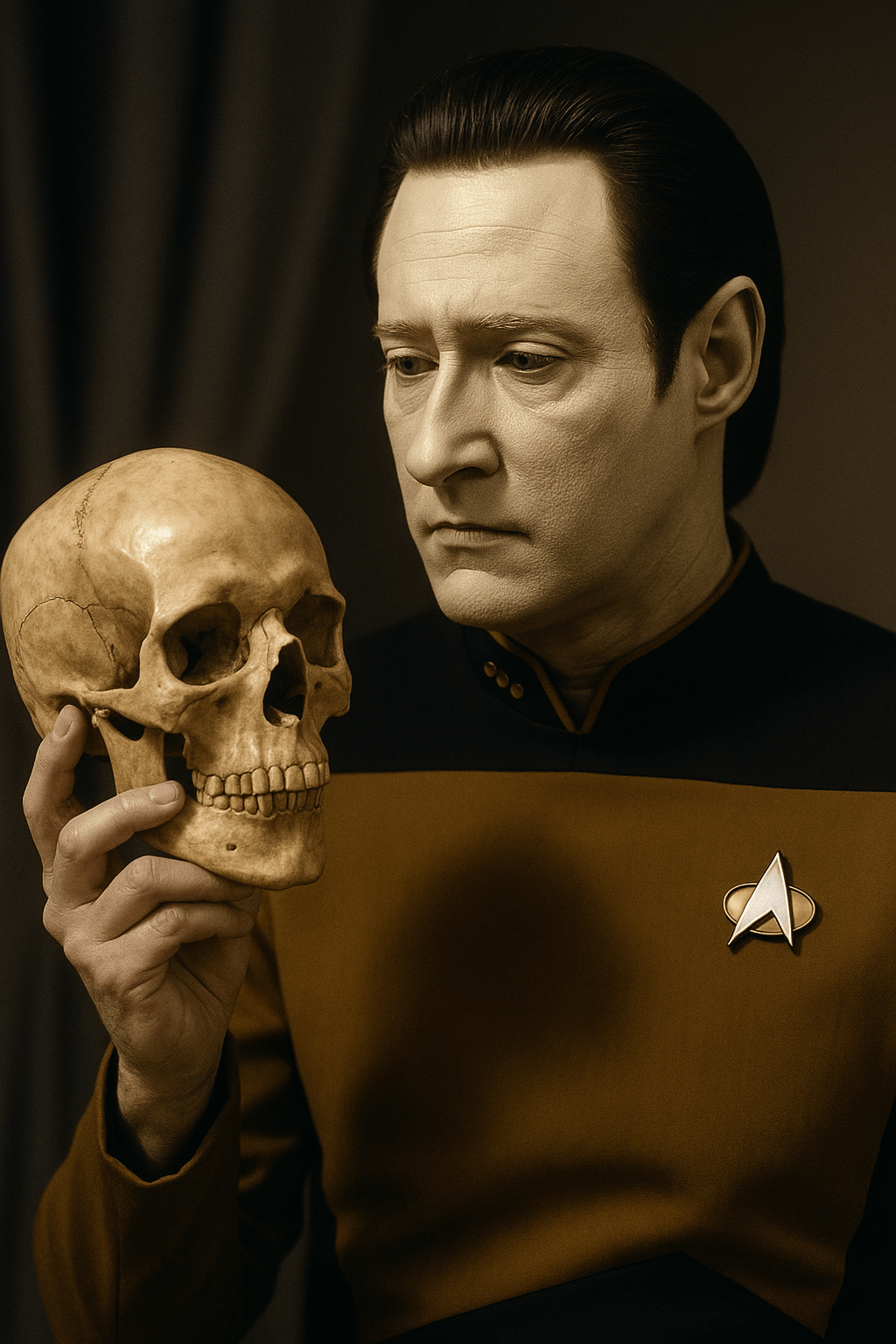
This is an assumptions that are almost always made in science fiction, and occasionally made in non-fiction writing about AI.
- Human Essence Assumption: There is some essential aspect of a human being that gives rise to all the other important aspects of a human being.
I am interested in the straightforward way we understand and accept this assumption, before we have had a chance to examine it or question it, as we do when we are casually watching science fiction or reading the paper.
I’ve written eight-ish articles about the assumption. Read The Sixth Day first; I think it is easiest way to convince you that (1) you understand what I’m talking about, and (2) you have occasionally accepted the assumption without question, at least when you were watching a movie.
This article is mostly a way to try to keep my thinking straight. But it might also be interesting to you all to understand the scope of the argument and make clear what I’ve actually proved.
Seven Aspects
Notice the category-neutral term “aspect” in the assumption — I am not talking about abilities, or properties, or sentience, or a subjective self, I am talking about any and all of these. At once. It says: “All the important aspects.” The HEA asserts that all these (ontologically different) aspects have the same source, some singular essence.
I think I can capture most or all of these candidate “aspects” and potential “essences” in these seven categories.
- Human behavior. In The Tell, I discussed the behaviors that demonstrate our “humanity”.
- Consciousness as a thing or “self“. Metaphysical objects and substance dualism is covered in Ghosts and Other Invisible Stuff.
- Subjectivity. What it feels like to perceive, think, feel and act from a first person point of view. The Paradox of Mary and Mark tried to convince you that you already know what “subjective consciousness” is. Also known as sentience, subjective consciousness, or subjective self-awareness.
- Mental Experience. This all the things that you experience as happening inside your mind: your train of thought, inner speech, attention, imagination, memory, thoughts, plans, etc.. All the contents of your consciousness, including everything that makes you be you. I couldn’t come up with a charming sci-fi example or thought experiment for this, but I did discuss subjectivity in The Paradox of Mary and Mark, and mentioned “mental experience” in the table at the end, where I contrast the subjective mental experience with objective mental functionality.
- Mental Functionality / Simulated Mental Experience. Classical AI simulated the way the mind uses mental objects like plans and goals (e.g. Newell & Simon’s means-ends-analysis). 20th century neuroscience has tried model what the brain is doing when we are “conscious of” something (e.g. Global Workspace Theory). These models are a form of information processing. I examine the relationship between these models like these and subjectivity in Characters, human sympathy in The Stepford Scenario and intelligence in The “I” in AI.
- Human Sympathy. We feel differently about “persons” than “machines”. The Stepford Scenario tried to determine what, exactly, it is that we care about. This is the central issue in most science fiction films about AI — in Considering Samantha I consider the role sympathy plays in the movie “Her”.
- Intelligent behavior. Today, in 2026, it’s common to refer the kind of intelligent behavior we’re talking about as “artificial general intelligence”. This is a behavior or ability — it’s something the thing can do. I talked about how the field of AI research defines intelligence in The “I” in AI.
A few observations.
- No less than four of the aspects above are sometimes called “consciousness”. This makes “consciousness” a very misleading term when used casually. We have to separate (1) metaphysical consciousness (2) subjective consciousness (3) subjective mental experience (4) mental functionality / simulated mental experience / artificial consciousness. The word consciousness is also used to mean (5) “personhood” or “self” — that is, it can refer to the human essence itself.
- The aspects above are all of a very different kind. We have an invisible thing, some behaviors, various types of information processing, an effect on people, and experiences. Their differences are intrinsic and significant. (Philosopher would say that they have a different “ontological status” or “mode of being”.)
- Human behavior, intelligent behavior and simulated mental experience can all be produced by information processing. It’s the “same” information regardless of how it is represented, it’s the “same” behavior regardless of who or what is doing it. With these there is no difference between a simulation of a thing and the real thing.
- Mental experience, subjectivity, metaphysical consciousness are problematic and their very existence leads to paradoxes.
- Human sympathy is central to this whole subject. It is the ground of morality, law, relationships and society. We experience it very directly and believe in very deeply. No matter what else we discover, we have to acknowledge how human sympathy works and that it matters.
The Relationships
The key entailment of the HEA is that it predicts a correlation between each pair of these things.The HEA implies a whole set of assertions like this:
- Emergence (Sufficiency I->>SC): Consciousness will emerge if superintelligence is present.
- The Tell (Sufficiency HB->>HS): If a robot behaves like a person, then it should be considered a person.
- Amodei’s Error (Sufficiency MF->>SC): If a robot has integrated information (ITT), then it has subjective consciousness.
I’m considering seven aspects, which gives us 21 relationships. I’ve covered (almost) all of these relationships in the previous articles. (Some essays lump together similar things and refute several links simultaneously.)
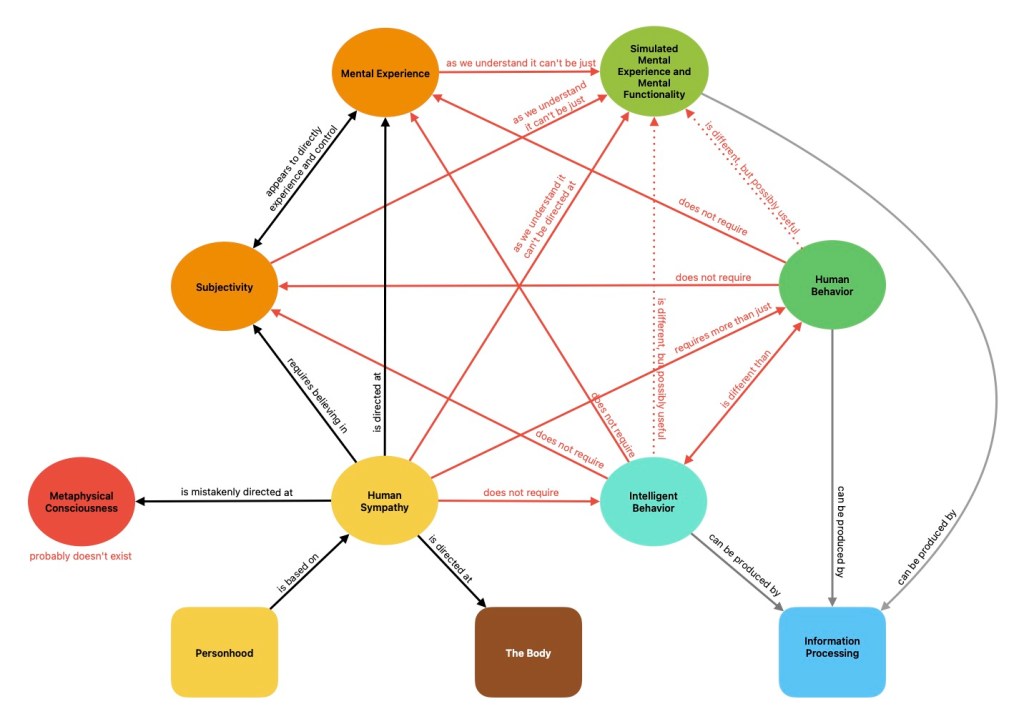
Most of the differences immediately fall out and are easy to see. (And I hope you’ve been patient when I’ve belabored the obvious.) Normally the essence is unexamined and nebulous — even when it feels familiar and obvious — but as soon as you reach into the concept and begin to deconstruct it, it doesn’t take long to see that it was nonsense.
The majority of my work in the previous six articles has been to disprove statements like the ones above, to show that various aspects aren’t necessary or sufficient for each other — that they different things an are, in general, independent of each other (with a few exceptions).
Hopefully, all these refutations will convince you that there is absolutely no evidence to support the human essence assumption.
Two Theories of How This Works
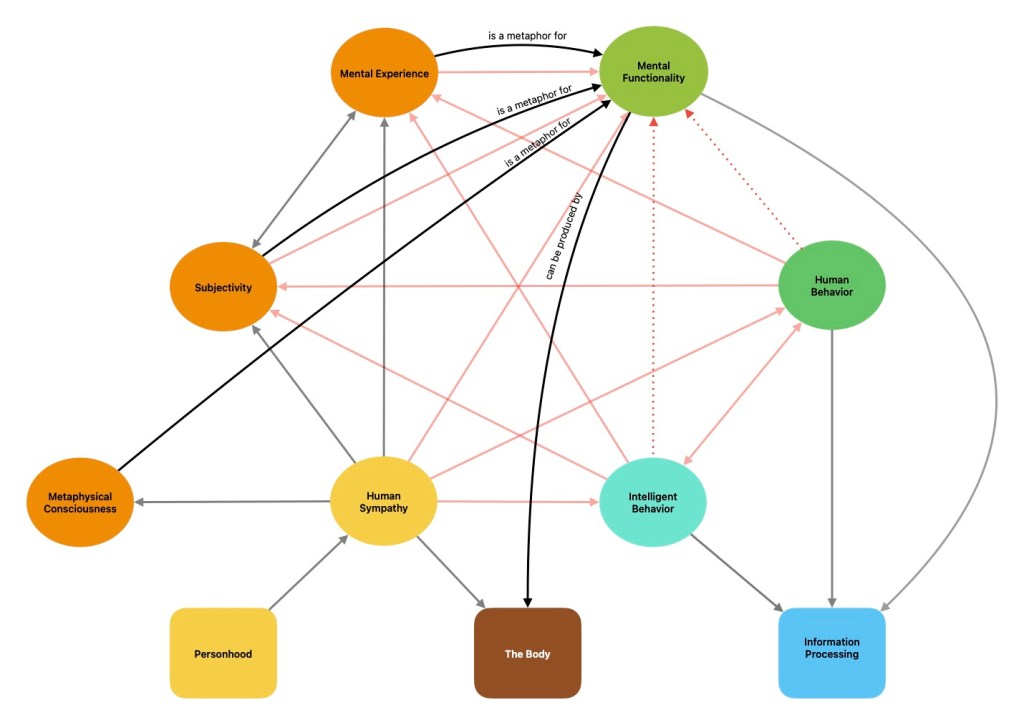
Functionalism, computationalism and eliminative materialism all hold something like this:
Substance dualism works like this:
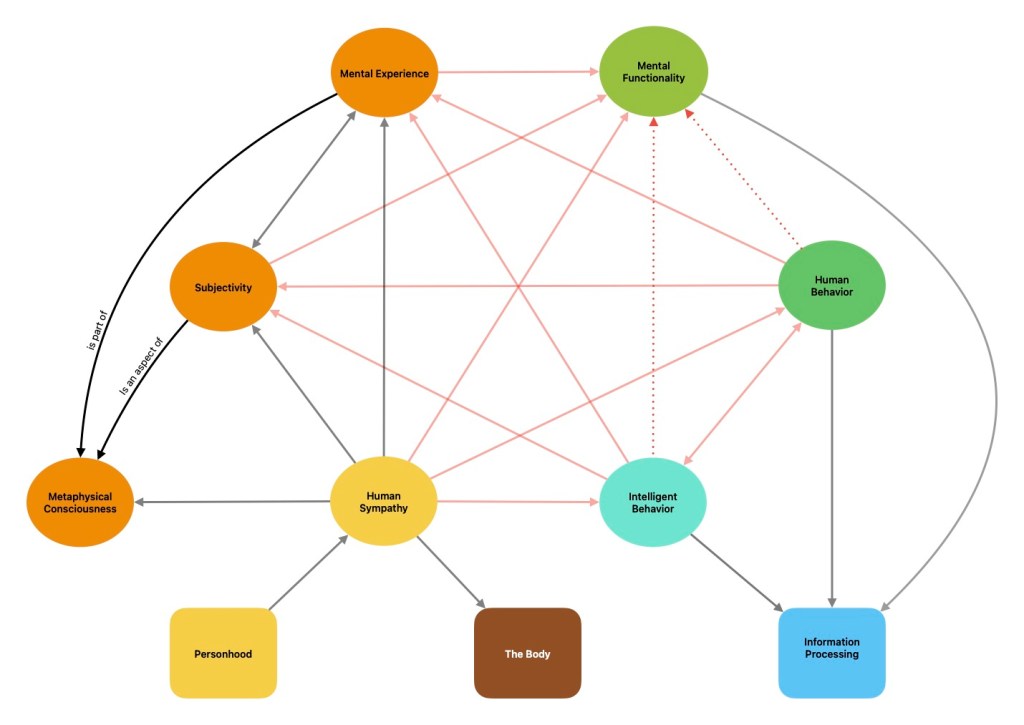
Some observations:
- EM implies that the “soul”, “subjectivity” and “mental experience” are all, at best, just useful ways of looking at what’s happening in brains. They are the same kind of thing.
- Neither does anything to rescue the human essence assumption. All the red links are still there. They are few more links between various aspects of consciousness, but this does nothing to pull the whole thing together — intelligence, for example, is still not connected to anything else.
- Subjective consciousness is neither necessary nor sufficient for intelligent behavior. The “I” in AI,
- Human Sympathy does not require Intelligent Behavior. The “I” in AI, one sentence, final section. “We care about our children even if they are stupid.”
- Human Sympathy as we experience it, cannot be directed at Simulated Mental Function. The Stepford Scenario, under “Mental Experience”


One thought on “Refuting the Human Essence Assumption”