what is “intelligence”?
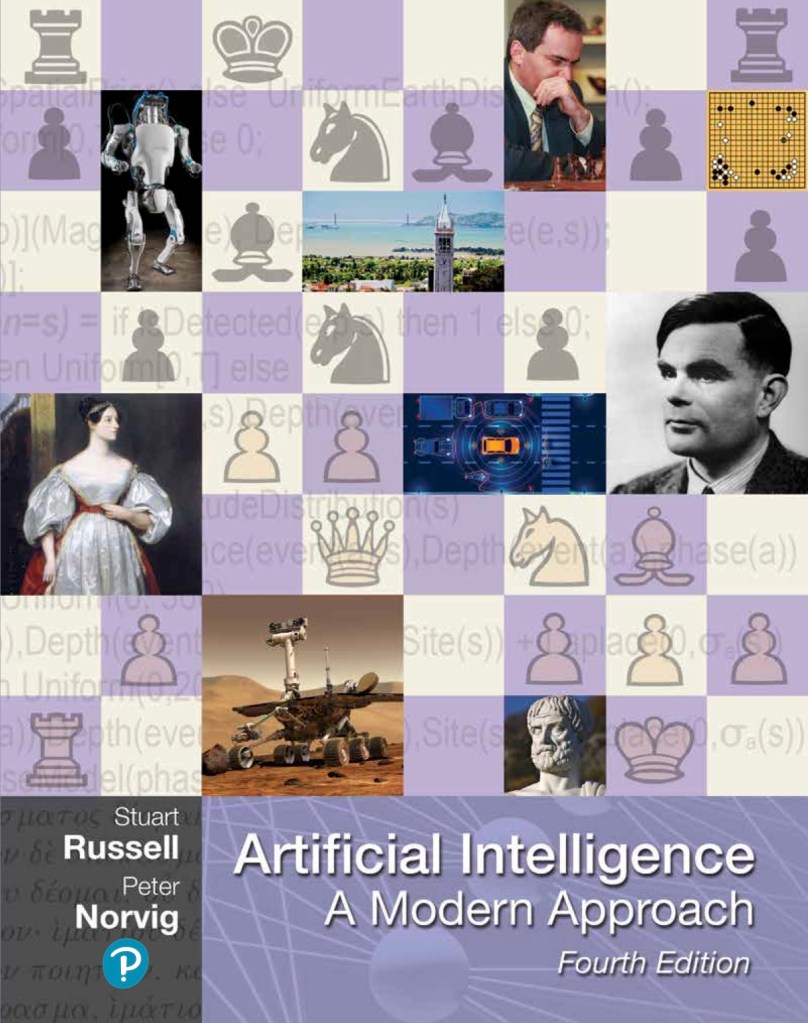
It’s weird that in a set of articles about AI, I’m only finally getting around to talking about what the field of A.I. research has to say. This article relies on the leading AI textbook, part Bible and part encyclopedia: Stuart Russell and Peter Norvig’s Artificial Intelligence: A Modern Approach.
Intelligence
Professional and academic research into AI generally avoids trying to define “intelligence” (mostly, I think, because of the kind of philosophical problems I’m talking about in these articles).
They have crafted careful definitions of what they are trying to do with machines. Russell and Norvig define AI research as “the study and design of rational agents” where a rational agent is anything that (1) has a goal (2) acts in the world to achieve that goal.
These goals are defined by a “utility function” or “objective function”. This is a kind of test that produces a number that tells the program how well it accomplished its goal. As far as the program is concerned, the goal is to increase that number. Machine learning programs know how to change themselves to make that number keep going higher as they keep doing their job over and over, better and better.
For example, a large language model is trained on a (huge) amount of text. The program tries to guess what the next word is going to be. If it guesses right, the number goes up. If it guesses wrong, the number goes down. It does this trillions of times, and every time it guesses right or wrong, it tweaks the numbers in a matrix in a way that makes the number go up more than it goes down.
Artificial intelligence thus defines “intelligence” in terms of well-defined problems with well-defined solutions. This definition has several advantages: (1) It’s measurable. (2) It uses the same mathematical language as economics, statistics, and optimization (for example the term “utility function” is from economics and “objective function” is from decision theory.) This means that results from these older, more successful fields could be applied to AI programs. (This in particular was what ended the AI Winter in early 2000s and has continued to drive AI’s recent success.)
If you think about it, the definition used by AI research isn’t that different than the one used by psychology. Psychometrics defines intelligence as “how well do you do on intelligence tests”, which might seem circular at first glance, however the number that they get (called “Q”) is very useful and reliable, perhaps the most reliable measurement in all of psychology. It correlates with many other important numbers (e.g. the likelihood that a person will succeed in school) and it’s highly heritable (which suggests that it is measuring something that is physically “real”).
Thus, in both AI and psychology: intelligence is defined in terms of well-defined problems with well-defined solutions, measured with tests that return numbers. That’s it. There isn’t any other scientific definition of “intelligence”.
Intelligence is Multi-dimensional
If we had to say what the overall “intelligence” of a program is, it would have to be a combination of how hard the problems are, how well the program solves them and how many different problems it can solve.
If this is the right way of looking at intelligence, then there is no simple way to put a single scalar number on the total “intelligence” of a thing. The whole idea of a linear scale for intelligence doesn’t make sense. We can only measure the machine on a problem-by-problem basis.
You could define an “index” by combining a number of problems (as an intelligence test does or the various benchmarks currently being use to test AI models), but this only obscures the problem. There are many different ways to put together an index and the theoretical justification of any index is profoundly arguable. Just as there’s no particular problem that is “most important”, there’s also no particular collection of problems that is most important.
Thus, intelligence is multi-dimensional. Every machine (or person) is at different levels of “intelligence” with respect to different problems. There are as many kinds of intelligence as there are kinds of problems. Even the “generality” of a machine’s problem solving abilities is a multi-dimensional convex region in problem-space.
So we have two key results that refute some of the assumptions we started with:
- There is no universal “level of intelligence”, no linear scale, that can be used to measure all things; “intelligence” can’t be the basis of the Chain of Being.
- There is no hard threshold, built into the universe, that divides the “intelligent” things from the “non-intelligent” things. As a machine becomes more capable of solving problems, there will be no singular moment when the machine crosses over to a “higher level” to become “fully intelligent”; we should not expect the coming of a “6th Day” for intelligence.
Human-Level Intelligence
“Human-level” intelligence is measured by how well an average human can solve a particular problem — the human level is different for every problem. (That is, it’s a convex region in infinite-dimensional problem-space.) For some of these problems, computers have outperformed humans 70 or 80 years. For others, they still can’t solve them as well as we can. (But the list of such problems has become rather short and is getting shorter.)
Average-Human-level and Best-Human-Level performance on a problem are interesting from a practical point of view, because this effects real world decisions: businesses and everyone else has to decide at what point they should accomplish a task with a machine rather than an employee.
But human level performance is uninteresting if we’re talking about something that machines are already better at. For example, the “human level of intelligence at multiplication” isn’t a measure anybody needs. There’s no reason to think that it will be any more significant for any problem, once the machines become good at it.
Human intelligence is unique and powerful. We know of no other natural thing that can solve such a wide variety of problems as well as we can. But the particular set of problems we are good at is partly accidental, the result of how our brains are built and what our culture has stumbled upon. There’s no evidence that human intelligence (that is, the class of problems we are especially good at) is uniquely exceptional or represents some kind of important milestone for machines.
Intelligent Behavior vs. Human Behavior
Russell and Norvig dismiss the Turing Test succinctly:
Aeronautical engineering texts do not define the goal of their field as making “machines that fly so exactly like pigeons that they can fool even other pigeons.”
The purpose of AI research is to build programs that can solve difficult problems, and human simulation is just one of those problems, useful for user interfaces, customer service, video game characters, works of art and pornography. But these are applications of AI — none of them necessarily require the simulation to have a high level of intelligence.
AI research doesn’t need machines that “think like human”. It needs them to solve problems that humans solve by “thinking.” This is a different thing. What we need are machines that can solve problems. Especially problems we can’t solve.
What makes a car useful is how different it is from people. A car doesn’t have legs, it doesn’t run, it just solves problems that people used to solve by running. If it was just like a person, it would be useless.
Intelligent Behavior vs. Subjective Consciousness
In The Paradox of Mary and Mark we talked a little bit about the problem of other minds: there is no way to determine whether or not a machine has subjective consciousness from the outside. There’s nothing stopping you from building a machine that is just acting like it has subjective consciousness and no one could tell the difference.
This means that: subjective consciousness is perfectly useless for artificial intelligence. If they built a machine that had subjective conscious experience, no one could tell. Why would they go to all the trouble to build a feature into a program that no one can detect?
Russell and Norvig wrote in 2003:
We agree with Turing—we are interested in creating programs that behave intelligently. The additional project of making them conscious is not one that we are equipped to take on, nor one whose success we would be able to determine.
Intelligent Behavior vs. Mental Functionality
There are algorithms that implement some of the things that the brain appears to be doing when you experience subjective consciousness, like “inner speech” or the “train of thought” or the way our attention system broadcasts information to the entire brain. In 2021, Russell and Norvig amended their opinion to take these into account.
Individual aspects of consciousness—awareness, self-awareness, attention—can be programmed and can be part of an intelligent machine.
Simulated mental function may be useful for certain problems. However, the wisecrack about the pigeons still applies; again, we’re not simulating human thinking here, we’re solving problems that humans normally solve by thinking.
Intelligence vs. Essence
We’ve just showed that intelligence has no special relationship with other human aspects, like human behavior or subjective consciousness or mental experience. I didn’t talk about it here, but it has no relationship with humans sympathy either. (E.g., we would love our children even if they were stupid. Enough said). Simulated mental functionality (such as attention mechanisms and so on) may be useful to intelligence, as Russell and Norvig mentioned above. And obviously, it has no relationship with metaphysical consciousness because, well, it doesn’t exist.
None of these other “important aspects of a human being” require intelligence or reliably produce intelligence. This proves that “intelligence” isn’t be the essential aspect of human beings that makes them different from all other things in the universe and brings all the interesting properties of human beings with it.

